
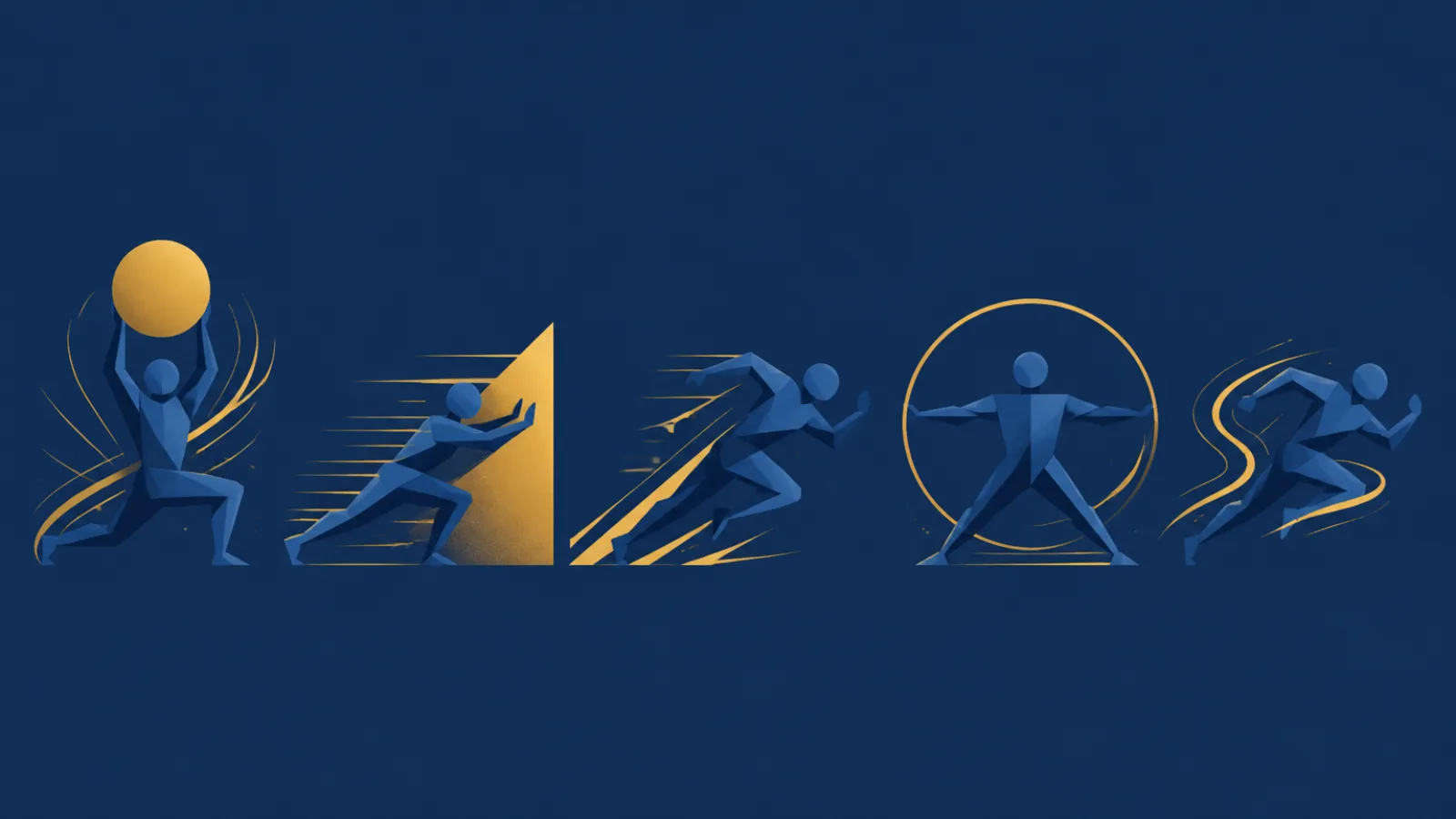
The 5 Army Fitness Test Events
The AFT was developed by Army Training and Doctrine Command (TRADOC) and became effective June 1, 2025, replacing the Army Combat Fitness Test. The 5 events were selected to assess the physical demands of modern Army operations across strength, anaerobic capacity, and aerobic endurance.
| Event | Abbr | What It Tests | Equipment | Direction |
|---|---|---|---|---|
| 3-Rep Max Deadlift | MDL | Lower-body strength | Hex bar, weight plates, safety collars | Higher is better |
| Hand-Release Push-Up | HRP | Upper-body muscular endurance | None | Higher reps is better |
| Sprint-Drag-Carry | SDC | Anaerobic capacity and agility | Sled, kettlebells, stopwatch | Lower time is better |
| Plank | PLK | Core strength and isometric endurance | None | Higher time is better |
| Two-Mile Run | 2MR | Aerobic endurance | Stopwatch | Lower time is better |
Event 1: 3-Rep Max Deadlift (MDL)
What it tests
Equipment
How it works
Scoring
What it replaced
Common mistakes
Event 2: Hand-Release Push-Up (HRP)
What it tests
Equipment
How it works
Scoring
What it replaced
Common mistakes
Event 3: Sprint-Drag-Carry (SDC)
What it tests
Equipment
How it works
- •Sprint: Run 25 meters and back at full speed
- •Drag: Pull a weighted sled backwards 25 meters and back
- •Lateral: Shuffle sideways 25 meters and back without crossing feet
- •Carry: Pick up two kettlebells and walk or run 25 meters and back
- •Sprint: Run 25 meters and back at full speed
Lower time equals a higher score.
Scoring
What it replaced
Common mistakes
Event 4: Plank (PLK)
What it tests
Equipment
How it works
A key feature of the PLK: it is the only AFT event with completely gender-neutral scoring. Males and females use identical scoring tables for the plank. This differs from the MDL, HRP, SDC, and 2MR which use separate tables for General standard males and females.
Scoring
What it replaced
Common mistakes
Event 5: Two-Mile Run (2MR)
What it tests
Equipment
How it works
The 2MR reflects the aerobic endurance needed for sustained combat support operations. For soldiers with approved medical profiles, alternate events are available: 2.5-Mile Walk, 12km Bike, 1km Swim, or 5km Row. These are Go/No-Go only and do not earn points on the 0 to 100 scale.
Scoring
What it replaced
Common mistakes
How AFT Events Are Scored
Each event is worth 0 to 100 points for a maximum total of 500 points. To pass the AFT:
- •Every event must score 60 points or above. Failing any single event means failing the test regardless of total score.
- •General standard soldiers need 300 total points minimum.
- •Combat MOS soldiers need 350 total points minimum using sex-neutral scoring tables.
Scoring is age-normed for most events, meaning the required performance to earn a given point value varies by age group. There are 10 age groups from 17 to 21 through 62 and above.
See complete scoring tables →AFT Events Compared to ACFT and APFT
A comparison showing which events existed in each test:
| Event | APFT | ACFT | AFT |
|---|---|---|---|
| Push-up | Yes (standard) | Hand-release | Hand-release |
| Sit-up | Yes | No | No |
| Leg Tuck | No | Early versions | No |
| 2-Mile Run | Yes | Yes | Yes |
| Deadlift | No | Yes (hex bar) | Yes (hex bar) |
| Standing Power Throw | No | Yes | No |
| Sprint-Drag-Carry | No | Yes | Yes |
| Plank | No | Later versions | Yes |
Key transitions:
- •Sit-ups were removed when the ACFT replaced the APFT. The plank replaced the sit-up as the core endurance test.
- •The leg tuck was controversial in the ACFT because many soldiers could not perform it. The Army transitioned to the plank as an alternative and the AFT uses only the plank.
- •The Standing Power Throw was removed for the AFT. It was the most equipment-dependent and least transferable event in the ACFT.