
How to Read the AFT Score Chart
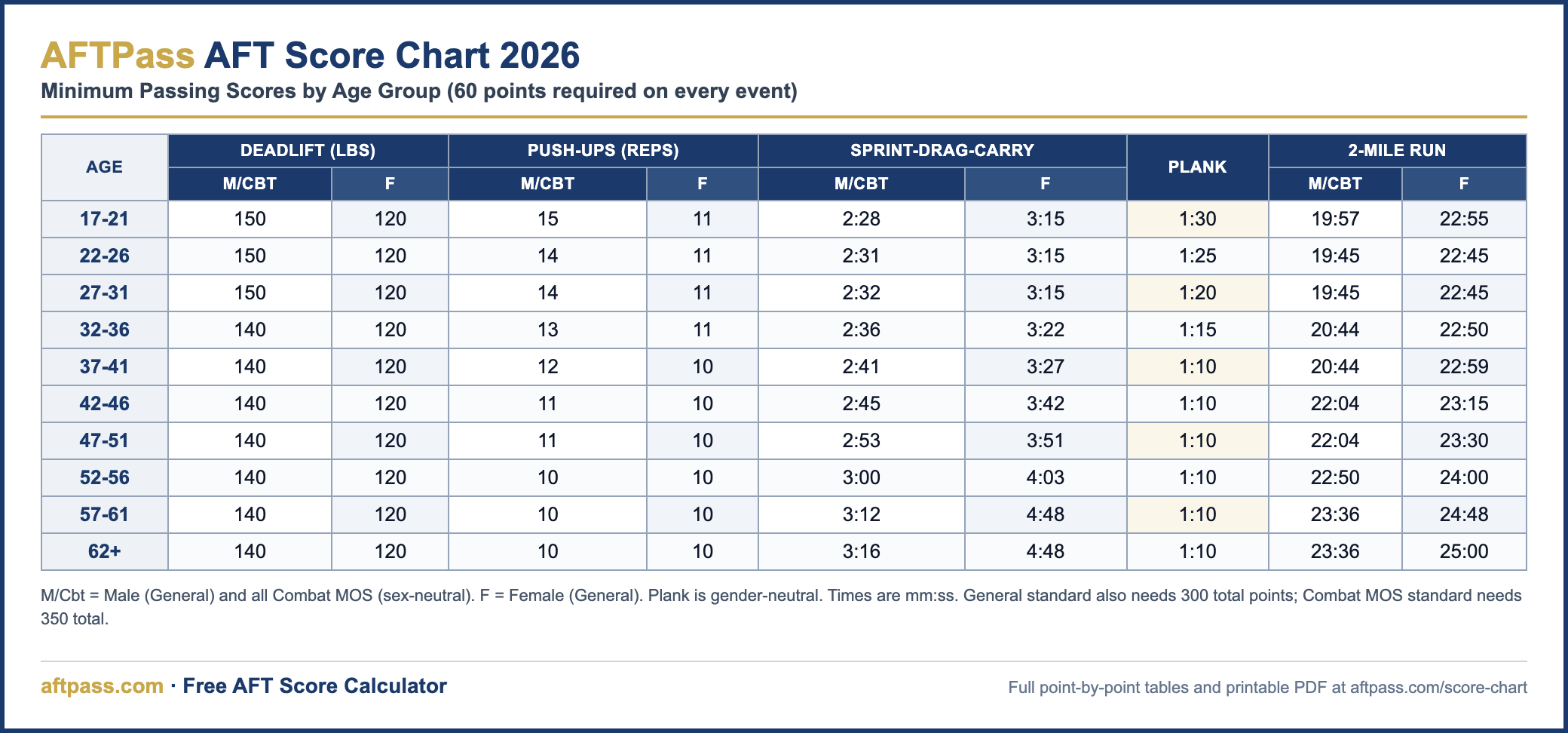
The AFT score chart converts a raw performance, a weight lifted, a number of reps, or a time, into a point value from 0 to 100 for each event. Your total is the sum of all five event scores, out of a maximum of 500. The chart looks dense at first, but it answers one simple question for every event: how many points does my result earn for my age and standard? Once you know how the columns work, it takes seconds to read.
Find your age group first
Scoring is normed by age, so every soldier is measured against people in the same bracket. Use your age on the day of the test, and read from the row for that bracket. The standards ease slightly as the brackets rise, which is why the same two-mile time can be worth 70 points for a 25 year old and more for a 45 year old. Always start by locating your bracket, because a result read against the wrong age row will give you a score you will not actually earn.
Know which column applies to you
Most events use separate male and female scales on the general standard, because the general standard is normed by both age and sex. The plank is the exception: it is scored on a single scale for everyone. Soldiers held to the combat standard, those in one of the 24 designated combat specialties, read a single sex-neutral column instead, and need 350 total rather than 300 to pass. If you are unsure which standard applies to you, it comes down to your MOS, not your unit or assignment.
Higher is better on three events, lower on two
For the deadlift, hand-release push-up, and plank, a bigger number, more weight, more reps, or more time, earns more points. For the sprint-drag-carry and the two-mile run, a lower time earns more points, since those events are timed. When you read the chart, make sure you are moving in the right direction: on the run, the fast times sit at the top of the scale, and on the deadlift, the heavy lifts do.
When your exact result is not listed
The chart lists point values at set intervals, so your exact rep count or time may fall between two listed rows. When that happens, your score is the value for the nearest result you have fully met, never the one you fell short of. If 40 push-ups earns 82 points and 41 earns 83, then 40 reps is an 82: you do not get credit for a rep you did not complete. The AFT calculator handles this automatically, so if you want your total without reading the tables by hand, enter your raw numbers there and it applies the correct point value for every event.
What the totals mean
Passing requires at least 60 points on every event and a qualifying total: 300 on the general standard, 350 on the combat standard. Falling below 60 on any single event fails the whole test regardless of your total. Above passing, the totals worth aiming for depend on your board: every 5 points above 300 adds 3 promotion points, so a 400 is worth 60 and a 450 is worth 90. The chart is where you work out exactly what each event needs to contribute to hit those marks.
Use this chart on your site
Run an ROTC program, unit page, or military blog? This chart is free to share. Both options below link back to AFTPass so your readers can reach the full tools.
Embed the chart image
Paste this where you want the chart to appear. It stays current because the image is hosted here.
Or just link to it
A plain text link back to the chart.